


Want to see how well your Google ads campaigns can really perform?
It’s time to let us push that performance to the next level.
Fill in the form and we will get back to you.
Let's Talk
Semaphore Search runs pay per click advertising for Perth businesses from $900 a month, across Google Ads and Microsoft Ads. It is run by Justin Clark, who has spent 18 years inside paid search accounts and managed more than $60 million in ad spend.
No lock-in contracts, no account managers, and no monthly report that quietly avoids the only question that matters: did the money come back?

PPC management with Semaphore Search starts at $900 a month, agreed up front, month to month. The fee is based on your ad spend and how much work the account needs, not a percentage of spend, because a percentage pays me more for spending more of your money and that is a strange thing to want from the person guarding your budget.
Your ad spend is separate. It goes straight to Google or Microsoft, from your own account, which you own outright.
For that you get the whole job:
Not sure what state your account is in? Start with the . Fixed price, documented findings, no obligation to hire me afterwards.
Between about $3 and $60 a click, depending on what you sell. Those are Google’s own Perth averages from August 2026, grouped here by category. The keyword-by-keyword table, fifteen Perth search terms with their monthly volumes, is on the page.
| Category | Perth search terms sampled | Average CPC range |
|---|---|---|
| Commercial and B2B services | 1 | $61 |
| Trades and home services | 10 | $6 to $34 |
| Legal and conveyancing | 3 | $12 to $27 |
| Removals and consumer services | 2 | $3 to $19 |
| Health, dental and aged care | 3 | $8 to $13 |
Two things follow from those numbers. First, in most Perth service categories you are paying somewhere between the price of a coffee and the price of a decent lunch every time somebody clicks, whether or not they were ever going to buy. Second, the difference between a well-run account and a neglected one is not a few percent. It is routinely half the budget.
Cost per lead is the number that actually matters, and it depends on how many of those clicks turn into an enquiry and how many enquiries you close. That arithmetic is in the budget section below.
Figures: Google Ads keyword planner data, Perth, Western Australia, nineteen service-industry search terms. Last updated 18th August 2026.
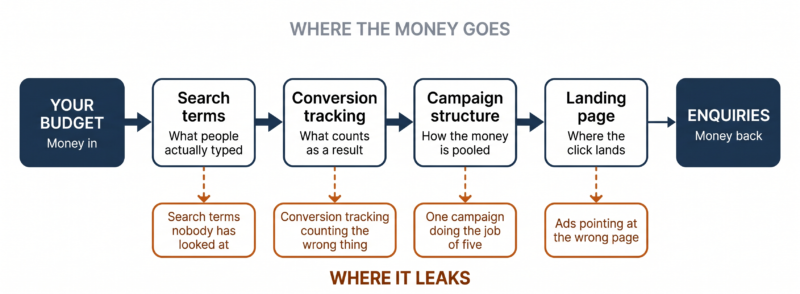
When I take over an account, the leaks are nearly always in the same four places:
You do not need me to do any of this, and it will tell you in twenty minutes whether your PPC is being managed or just billed for:
If any of those turn up something ugly, that is what the is for.
Paid search is not just Google, although Google is where most of the money goes and where I start. Depending on what you sell:
You will not be sold campaign types you do not need. If Search plus remarketing does the job, that is the recommendation you will get. If Google is the whole picture for you, the page goes into that service on its own.
Not monthly. Weekly. This is the bar to hold any PPC agency in Perth to, including me:
None of that is exciting. All of it compounds. An account left alone for a month does not stand still, it drifts, because the auction and the automation keep moving whether anyone is watching or not.
There is no universal number, and anyone who gives you one has not asked what you sell. The honest framework is three questions:
What is a customer worth to you? Not the first sale, the whole relationship. What share of enquiries do you close? How many extra customers can you actually handle? Those three numbers set your maximum sensible cost per lead, and your budget follows from that, not the other way around.
The practical floor is whatever buys enough data to learn from each week. Below that, you are not running a campaign, you are running a lottery. If your budget is not there yet, I will tell you in the first conversation and point you at what to do instead. Paid search is also not always the right first move: if your buying cycle is long and your margins are thin, may be the better place to start.
Over 18 years I have run paid search for local trades and home improvement firms, medical and allied health practices, professional services, B2B suppliers, hotels and travel brands, and ecommerce retailers from startup up to some of the largest in Australia and New Zealand.
The thing that predicts whether this works is not the industry. It is a business that knows what a customer is worth, has the capacity to take on more work, and wants a straight answer about where the money went. Semaphore Search is deliberately small, which means a short client list and the person you speak to being the person in the account. More on that on the .
Semaphore Search runs PPC for businesses across Perth: Fremantle, Melville, Applecross, Cockburn, Joondalup, Osborne Park, Canning Vale, Midland, the CBD and everywhere between. Clients elsewhere in Western Australia and interstate get exactly the same service, with calls instead of coffees.
Semaphore Search
37 Foss Street, Bicton WA 6157
Phone:
Email:
Hours: Monday to Friday, 9am to 5pm AWST
PPC management is the ongoing running of your paid advertising accounts: campaign structure, keywords and search terms, ad copy, bidding, budgets, conversion tracking and reporting. It is continuous work rather than a one-off setup, because the auction, your competitors and the platform’s automation all keep changing whether anyone is watching or not.
PPC, or pay per click, is the advertising model: you pay each time somebody clicks your ad. Google Ads is the largest platform that sells it. Microsoft Ads, Meta and LinkedIn also run on the same model. In practice, when a Perth business asks about PPC they usually mean paid search on Google, often with Microsoft alongside it.
Most Perth agencies charge between $500 and $2,500 a month, either as a flat fee or as a percentage of your ad spend, typically 10 to 20 per cent. Semaphore Search charges a flat fee from $900 a month, agreed before anything starts, with no lock-in contract and no percentage clip.
Day to day, a PPC agency structures your campaigns, chooses and prunes the keywords and search terms your ads show for, writes and tests the ads, sets bids and budgets, keeps conversion tracking honest and reports on what came back. The weekly list further up this page is what that looks like in practice. The difference between agencies is rarely the list. It is whether anyone is actually doing it every week, and whether the person doing it is the person you spoke to.
There is no good number in isolation, only a good number relative to what a customer is worth. A $60 click is cheap if a customer is worth $5,000 and you close one in five. A $6 click is expensive if the job is worth $150. Judge cost per acquisition, never cost per click on its own.
Yes. Microsoft Ads is usually cheaper per click and less contested, and in several categories the audience skews older and higher-income. It rarely carries a campaign on its own, but as a second front on a working Google account it often produces the cheapest leads in the whole media plan.
Check the change history in the account and read the search terms report. If nothing has changed in six weeks, and the search terms report is full of things you would never pay for, you have your answer. The five checks further up this page take about twenty minutes.
You can, and for a simple account with a small budget it can be a reasonable place to start. It becomes false economy when the spend gets big enough that a few percentage points of waste costs more than the management fee, or when the account gets complex enough that Google’s automated recommendations start doing real damage if accepted unread.
Paid results still sit above and inside AI-generated answers, and commercial searches remain the ones platforms monetise hardest. What has changed is that vague, informational keywords are getting less valuable while high-intent commercial ones are getting more so. That shifts how accounts should be structured, which is a reason to have someone watching, not a reason to stop.
PPC can deliver enquiries within days of going live. SEO typically takes three to six months to show meaningful movement, and longer in competitive categories. They do different jobs: paid search buys demand now, SEO compounds later. Most businesses that can afford both should run both, in that order.
If you are spending on paid search and cannot say what it returned last month, that is fixable, usually faster than you would expect. Book a free chat, or start with the $500 audit and get it in writing.
Want to see how well your Google ads campaigns can really perform?
It’s time to let us push that performance to the next level.
Fill in the form and we will get back to you.
Let's TalkSemaphore Search 37 Foss Street, Bicton WA 6157 0450 976 114