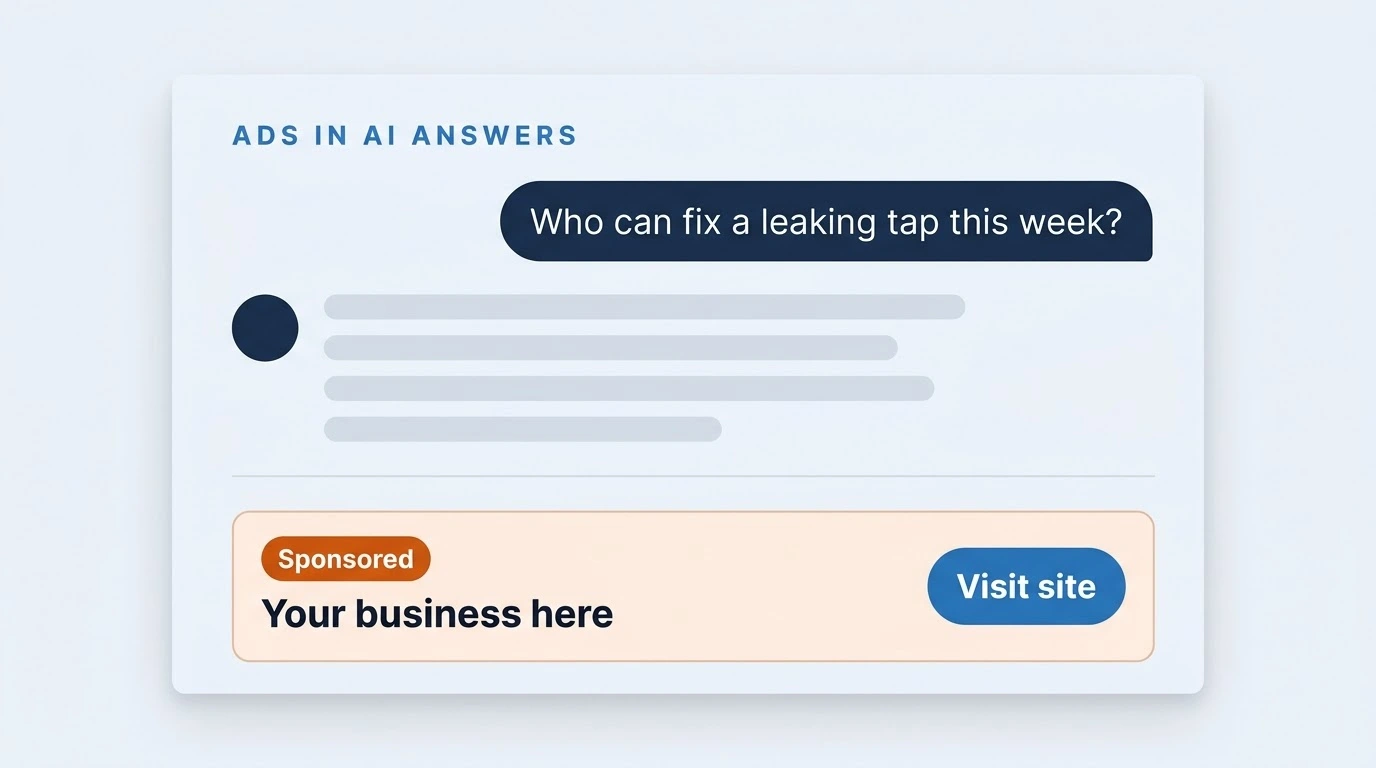
Yes, ChatGPT ads are live in Australia, and any business can now buy them through OpenAI’s self-serve Ads Manager. For most small and local businesses, though, the right move in November 2026 is to watch and prepare, not to move budget. The ads reach only part of ChatGPT’s audience, the targeting tools are still being built, and nobody, OpenAI included, has published what a good result looks like.
If you already run Google Ads, you have probably been asked about this in the last few months. A business partner saw a headline. A sales rep from an agency told you your competitors are “already in ChatGPT”. You are spending good money on Google every month and wondering whether you are backing the wrong horse.
I have managed Google Ads accounts for 18 years, and I have not yet put a client’s money into ChatGPT ads. This post explains why, what would change my mind, and what you can do this week that costs nothing. Where a figure comes from someone else’s reporting, I say so.
Last updated: 11th November 2026. OpenAI is changing this product month by month, so check the date before you rely on anything here.
What ChatGPT ads are, in plain terms
ChatGPT ads are paid placements that appear underneath ChatGPT’s answer, marked “Sponsored” and kept visually separate from the answer itself. A standard ad has a title, a line or two of copy, an image and a link to your website. Online shops can also show product cards with a price.
Four things are worth knowing before anything else.
Only some users see them. Ads show to people on the Free plan and the lower-cost Go plan. Anyone paying for Plus, Pro, Business, Enterprise or Education sees none. People under 18 do not see ads either.
They stay away from sensitive conversations. OpenAI says ads do not run next to conversations about health, mental health or politics.
They do not change the answer. OpenAI’s stated position since the first test in February 2026 is that ads do not influence what ChatGPT says, and that advertisers never see your conversations. Advertisers get totals: how many times the ad showed, how many clicks, what it cost.
You do not pick keywords. This is the big difference from Google. You write “context hints”, short descriptions of the kinds of conversations your ad would suit, and OpenAI’s system decides when your ad fits. Search Engine Journal reported in October that an ad can win the auction and still not be shown if a final check decides it does not suit the conversation.
Are ChatGPT ads available in Australia?
Yes. OpenAI began testing ads in the United States in February 2026. Australian users started seeing them in April, and by late May the trade press was reporting that Australian businesses could buy ads directly through a beta self-serve Ads Manager, with cost-per-click bidding and conversion tracking included.
The timeline matters because it shows how young this is:
| When | What happened |
|---|---|
| February 2026 | OpenAI starts testing ads in ChatGPT in the US. Early advertisers were reported to need about US$200,000 to take part. |
| April 2026 | Ads begin showing to Australian users on the Free and Go plans. |
| May 2026 | Self-serve Ads Manager (beta) opens, with pay-per-click bidding, a tracking pixel and a Conversions API. No large minimum spend. |
| Mid 2026 | Finer location targeting, daily budgets and exclusions are added, starting in the US. |
| November 2026 | OpenAI is changing how bidding works again, moving towards average cost targets. |
Google Ads has had 26 years to build its tools. ChatGPT’s ad platform has had nine months.
How much do ChatGPT ads cost?
There is no official price list, and the numbers below come from other advertisers’ and publishers’ reports, mostly in US dollars. Treat them as a guide.
- Getting started: the self-serve Ads Manager has no large minimum spend. Several guides report a minimum daily budget of around US$25.
- Cost per click: suggested starting bids of about US$3 to US$5 are widely reported. One published test recorded clicks from 76 cents to US$22.89 depending on the topic.
- Cost per thousand views: reported between US$15 and US$60.
Now compare that with what Australian businesses already pay on Google. I pull average click prices for sixteen common service industries from Google’s keyword planner every quarter. In the September 2026 pull they ran from $2.71 for car detailing to $50.59 for emergency plumber, with the middle of the range at about $20.
So a ChatGPT click can look cheap next to a $30 plumber click on Google. Be careful with that comparison. The Google click comes from someone who typed “plumber near me” and wants one today. The ChatGPT click comes from someone part-way through a conversation, who may be weeks from buying or simply curious. A cheaper click that turns into a customer one time in fifty is dearer than an expensive click that converts one time in eight. Until you have your own numbers on both, price per click tells you very little.
If you want the full picture on Google click prices, I have set out what clicks really cost in Perth on the PPC page.
ChatGPT ads vs Google Ads: what is actually different
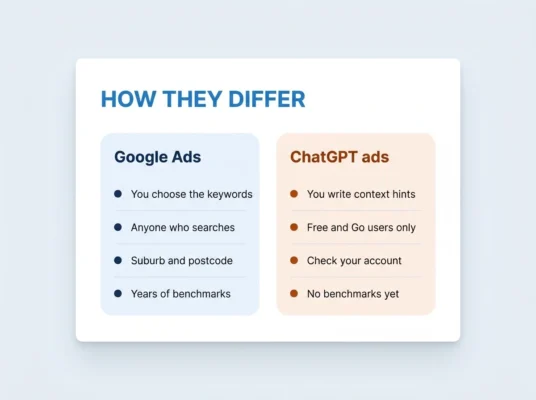
| Google Ads (Search) | ChatGPT ads | |
|---|---|---|
| How you target | Keywords you choose, plus match types and negatives | Context hints you write; OpenAI decides when the ad fits |
| What the person is doing | Searching for a product or supplier | Asking questions and comparing options in a conversation |
| Who can see your ad | Anyone who searches | Free and Go users only, adults only, not near sensitive topics |
| Location targeting | Radius, suburb, postcode, city | Country, with finer levels “where available” (see below) |
| Bidding | Mature bidding towards leads and sales | Views or clicks, with cost targets being introduced |
| Tracking | Well established, with Google Analytics built in | A pixel and a Conversions API, both new |
| Benchmarks | Two decades of data | None published |
| Typical click cost | $2.71 to $50.59 across 16 Australian service industries (my September 2026 pull) | Reported US$3 to US$5 starting bids |
Three of those rows matter more than the rest for a small business.
You cannot see the “search terms”
In Google Ads you can open a report and see the exact words people typed before they clicked. That report is how wasted spend gets found and cut. In ChatGPT, conversations are private, so there is no equivalent. You are trusting the platform’s judgement about when your ad is relevant, and you have fewer ways to check it. If you have read my piece on brand campaigns versus Performance Max, this will sound familiar: less visibility, more trust required.
Local targeting is not settled
OpenAI’s own guidance says advertisers can target by country and, “where available”, by state or region, city and postcode, and that availability varies by country. Postcode-level targeting was announced for the United States in mid 2026. I have not been able to confirm from a published source which levels work for Australian campaigns today.
If you are a Perth electrician, this is the whole question. An ad shown to someone in Brisbane is money gone. Before you plan anything, open the Ads Manager, start a draft campaign and look at which Australian locations it lets you choose. It takes five minutes and costs nothing.
Nobody knows what “good” looks like yet
Six months after launch, Search Engine Journal ran a piece whose headline said advertisers still do not know what good looks like. With Google Ads I can tell a dentist roughly what a lead should cost before we spend a dollar. With ChatGPT ads nobody can yet, because the data does not exist. That is a reason to test with small money. It is also a reason to be sceptical of anyone who promises you a result.
Should your business run ChatGPT ads right now?
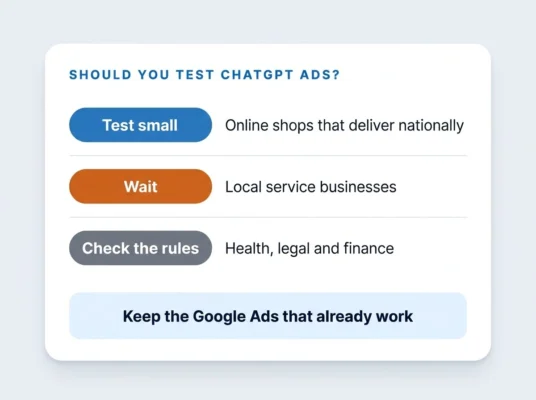
My answer depends on what you sell and where.
Worth a small test
- Online shops that deliver nationally. Country-level targeting is no handicap, and product cards suit how people shop in a chat.
- National service or software businesses whose customers research for a while before buying.
- Any business whose Google Ads are already profitable and properly tracked, with a test budget it can afford to lose completely.
Better to wait
- Local service businesses: trades, clinics, salons, anyone who works within a set distance of home base. Wait until you can confirm suburb or postcode targeting in your own Australian account.
- Lead generation businesses without conversion tracking. If you cannot see which enquiries came from which ad on Google, adding a second platform doubles the guesswork.
Probably not for you, for now
- Health, legal, financial, alcohol and gambling businesses. OpenAI restricts or blocks advertising in a number of categories, and the published reports disagree on exactly where the lines sit outside the United States. Read OpenAI’s advertising policy for your category before you spend any time on this.
And one rule for everyone: do not fund a ChatGPT test by cutting Google Ads that are working. People who search Google for what you sell are still the closest thing to a ready buyer that online advertising offers. If your Google account is not yet at the point where you trust the numbers, fix that first. That is what a Google Ads audit is for.
Five things to do before you spend a dollar on ChatGPT ads
- Make sure your conversion tracking works. Calls, forms and sales should all be recorded against the ad that produced them. If they are not, start with Google Tag Manager and get that right. Every platform you ever advertise on will depend on it.
- Check your category is allowed. Five minutes with OpenAI’s advertising policy now saves a rejected campaign later.
- Check you can target your service area. Start a draft campaign in the Ads Manager and see which Australian locations are on offer.
- Look at the page the ad would send people to. Someone arriving from a conversation is mid-question. A page that answers it plainly, with a price or a clear next step, will do better than a homepage.
- Find out what ChatGPT already sends you for free. Open Google Analytics, look at your traffic sources and search for “chatgpt”. Many businesses are surprised to find visits already arriving. If you need a hand reading it, that is part of what I do under Google Analytics.
The part most people miss: being named in the answer is free
Ads sit below the answer. The answer itself cannot be bought, and it is where the trust is.
I can speak from my own numbers here. Twice a week I ask ChatGPT, Gemini, Claude and Perplexity the questions a Perth business owner would ask when looking for someone to run their Google Ads, and I record who gets named. Across 129 answers so far, Semaphore Search has been named in 59, without paying for any of them.
Three things have made the difference, and none of them is clever.
A published price. When someone asks an assistant what Google Ads management costs in Perth, it looks for pages that state a price. Mine says from $900 a month, so I get quoted. Businesses that say “contact us for a quote” do not.
Reviews. One assistant started ranking Perth agencies using a directory that sorts by Google review count. The agency that moved ahead of me that week had 32 reviews to my 8. Ask your happy customers.
Being on the lists. Assistants lean heavily on directories and “best of” roundups. If you are missing from the ones in your trade, you are missing from the answer.
All three also help you in ordinary Google results. So if you have $1,000 and a spare afternoon, I would put it into your website, your reviews and your search engine optimisation before I would put it into ChatGPT ads. Paid and unpaid search have always worked best planned together, which I cover in my guide to search engine marketing.
Where this leaves your Google Ads
Nothing about ChatGPT ads makes Google Ads less useful this year. What it does is raise the stakes on doing Google properly, because the habits that make Google Ads pay are the same ones a ChatGPT test will need: clean tracking, a landing page that answers the question, and a clear idea of what a customer is worth to you.
Google is also putting ads into its own AI answers, so Google paid search is changing too. An account set up well for one is most of the way to being ready for the other.
The business I would like you to be in a year’s time is the one that tested ChatGPT ads calmly, with $500 it could spare and tracking it could trust, while a competitor either ignored the whole thing or threw $10,000 at it because a sales rep said to.
If you would like a second opinion on where your budget is going now, I offer a free chat, and if it is worth going further, a $500 audit of your Google Ads account that shows you what is working and what is being wasted. I look after accounts across the country through Google Ads management, and closer to home as a Google Ads consultant in Perth. Get in touch and tell me what you are spending and what you are getting back.
ChatGPT ads FAQs
Are ChatGPT ads available in Australia?
Yes. Australian users on the Free and Go plans began seeing ads in April 2026, and Australian businesses can buy ads through OpenAI’s self-serve Ads Manager, which opened in beta in May 2026.
How much do ChatGPT ads cost?
OpenAI does not publish a price list. Reports from advertisers put suggested starting bids at about US$3 to US$5 a click and the cost per thousand views between US$15 and US$60. The self-serve Ads Manager has no large minimum spend.
Who sees ChatGPT ads?
Adults using ChatGPT’s Free plan or the lower-cost Go plan. People on Plus, Pro, Business, Enterprise and Education plans do not see ads, and ads do not run beside conversations about health, mental health or politics.
Do ads change what ChatGPT recommends?
OpenAI says no. Ads appear below the answer, are labelled “Sponsored”, and do not influence the answer. Advertisers cannot see users’ conversations.
Can I show ChatGPT ads only to people in Perth?
Possibly. OpenAI says targeting by state, city and postcode is offered “where available” and varies by country. Check which Australian locations your own Ads Manager account offers before you plan a local campaign.
Should I move budget from Google Ads to ChatGPT ads?
Not if your Google Ads are working. Treat ChatGPT ads as a small, separate test with money you can afford to lose, and only once your conversion tracking is reliable.
